
Construction site noise protection
Mobile noise protection on construction sites: selection and planning
Guides
Mobile noise protection on construction sites: selection and planning
Mobile noise protection systems can reduce sound propagation on construction sites and thus the noise exposure of residents, schools and hospitals. Noise source, surroundings, set-up and a stable system are decisive – this guide helps with planning.
Request noise protection for your site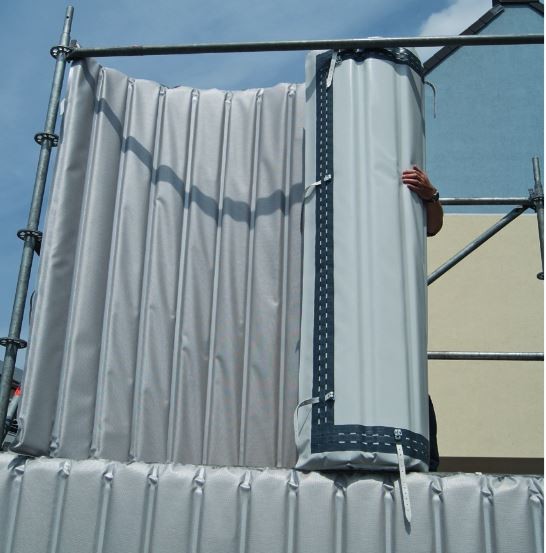
1. Record the site and protection goal
- Which machines and activities produce the main noise?
- Where are sensitive areas such as homes, schools, hospitals?
- Which working hours and construction phases are planned?
- How high are source and receiver, e.g. windows on upper floors?
- Which areas are available for barriers?
- Are there requirements, a noise forecast or measurement data?
First check low-noise methods, equipment and organisational measures. The mobile barrier is then planned to suit the remaining sound propagation.
2. Distinguish suitable solutions
| Solution | Typical use | Planning point |
|---|---|---|
| Acoustic mats for site fencing | Temporary screening along the work area | Support system, height, joints, wind load |
| Mobile noise barrier wall | Screening with defined wall build-up | Space, ground, stability |
| Enclosure, scaffold cladding | Protection close to the source, e.g. compressor or demolition | Ventilation, heat, fire protection, access |
Sound insulation measured in the laboratory cannot be converted directly into the achievable level reduction at the receiving location. Openings, flanking paths, distances and frequencies affect the result.
3. Plan an effective and safe set-up
Place the barrier as close as possible to the source or receiver to interrupt direct sound paths. Gaps and open sides reduce the effect considerably.
Clad site fences offer the wind a large surface. Supports, ballast, anchoring and permissible wind speeds must be defined for the specific system – improvised weights are no substitute for proof.
4. Legal and technical basis
In Germany, the AVV Baulärm regulation is relevant for assessing construction noise; requirements depend on the receiving location. Other countries have their own rules. At demanding sites, measures should be agreed on the basis of an expert assessment. Noise protection for workers must also be addressed in occupational safety.
5. Rent or buy?
Rental suits limited construction phases and changing projects, purchase recurring demand. Compare not only the system but also transport, installation, storage, maintenance and duration of use.
6. Check effect and condition
Check joints, damage and fixings regularly and after storms. If the construction process or machines change, adapt the protection. A smartphone app is no substitute for a professional noise measurement.
Matching products
Noise Protection SystemsNoise Protection MatsTraffic & Guidance Systems
Frequently asked questions
More guides
Concrete frost protectionCrash protection bollards
Request noise protection for your site
Send address, period, sketch or photos with distances and heights, noise source, required length and height, ground and rental or purchase.
This information is a general overview and does not replace applicable regulations, manufacturer instructions and your risk assessment.

Stock & Custom Solutions
Standard range from stock plus made-to-order solutions to your specifications.
Personal Expert Consultation
Direct contact with our experts – we find the technical solution for your problem.
Brand Quality
Products from renowned manufacturers – certificates and declarations of conformity per product on request.
Delivery DE & Nordics
Reliable delivery to Germany, Denmark, Norway, Sweden and Finland – Austria and Switzerland on request.