
Industrial cleaners
Choosing and using industrial cleaners correctly
Guides
Choosing and using industrial cleaners correctly
The right industrial cleaner removes the contamination and suits the surface, the process and the following step. Start with three facts – material, contamination and cleaning goal – rather than the strongest formulation available.
Request the right cleaner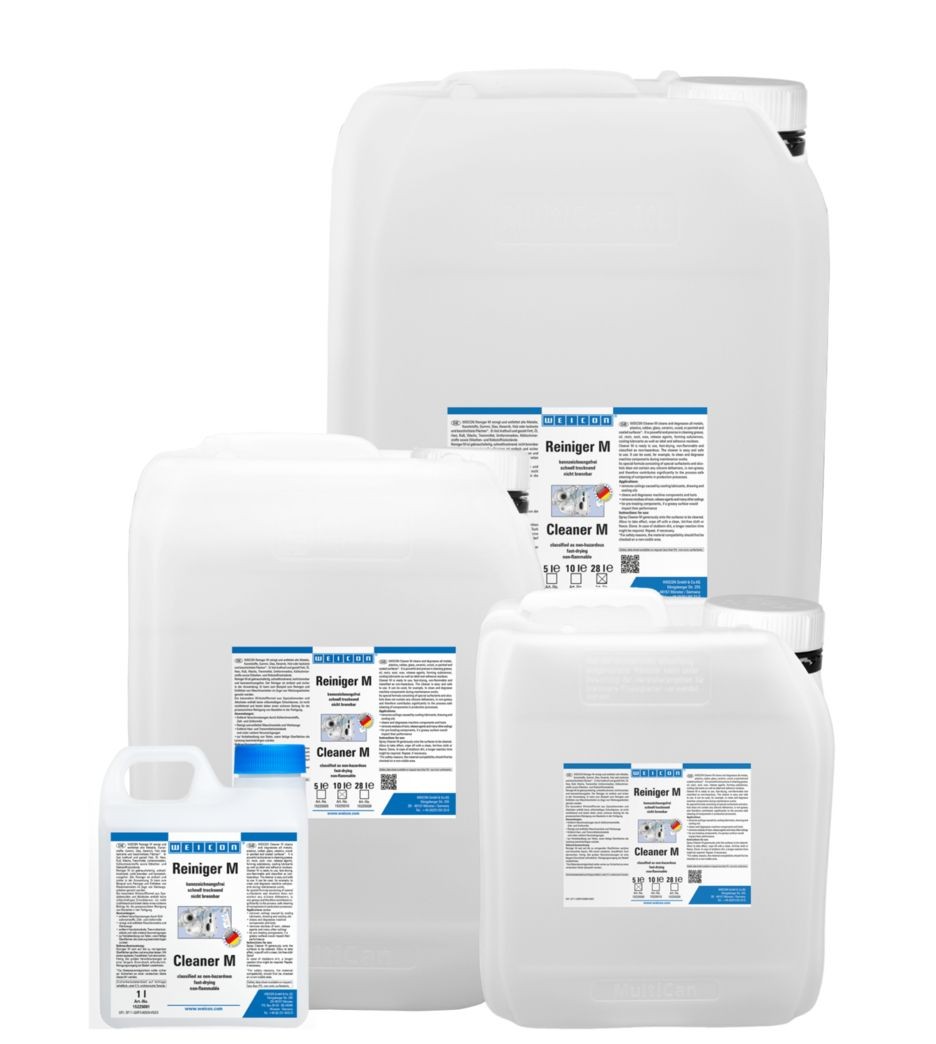
Define the cleaning goal first
Should visible dirt be removed, a surface degreased and prepared for bonding, or a hygienically defined condition achieved? These goals need different products and processes. Also describe the method: wiping, spraying, dip bath or machine cleaning.
Quick guide by contamination
| Cleaning task | Possible approach | Key check |
|---|---|---|
| Oil and grease | Degreaser or water-based industrial cleaner | Material, rinsing, next process |
| Label and adhesive residues | Adhesive or label remover | Paint, plastic, coating, adhesive type |
| Dust, light soiling | Mild, material-compatible cleaner | Moisture sensitivity, residues |
| Glass and smooth surfaces | Glass, surface or foam cleaner | Coatings, residue-free finish |
| Electrical components | Product approved for the component | Safe working conditions, manufacturer instructions |
The table is a pre-selection – suitability must always be checked on the specific product and substrate.
Key selection criteria
| Criterion | Questions for selection |
|---|---|
| Material | Which alloys, plastics, paints, coatings and seals are in contact? |
| Contamination | Oil, grease, adhesive, dust, limescale or mixed residues? |
| Method | How is the cleaner applied and how are residues removed? |
| Conditions | Which temperature, concentration and contact time? |
| Next process | Must the surface be dry, residue-free or ready for bonding? |
| Environment | Ventilation, ignition sources, hygiene requirements? |
"Plastic" or "metal" is usually too vague. A pH-neutral cleaner is not automatically safe for every surface either – the formulation and manufacturer instructions decide.
Concentrate or ready-to-use?
Ready-to-use products simplify application. Concentrates are economical for defined processes but require reliable dosing. More cleaner does not mean better results: overdosing increases rinsing effort, residues and cost. Compare consumption, labour time, drying and disposal – not just the container price.
Trial test before series use
- Read the technical and safety data sheets.
- Choose representative contamination and original material, test on an inconspicuous area.
- Document product, dilution, temperature and contact time.
- Assess cleaning effect, surface changes and residues.
- Rinse or dry according to product instructions.
- Document the approved application for recurring work.
Safety and food processing areas
- Include the safety data sheet in risk assessment and instruction.
- Never mix cleaners yourself; label containers clearly.
- Select gloves and protective measures per product; consider ventilation and ignition sources.
- Dispose of used cleaning fluid according to composition and regulations.
- In food areas, only use cleaners suitable for the specific application. For NSF A1 registered products, observe the registration conditions, protect food and packaging and follow required rinsing – A1 is no approval for direct food contact.
- A "citrus" name does not imply disinfection – that requires a product claimed for it.
Matching products
Cleaners & DegreasersHazardous Material Storage & Environmental ProtectionSpill Containment Trays & Drum Handling
Frequently asked questions
More guides
Request the right cleaner
Tell us material, contamination, method, current product and demand – a photo helps narrow it down.
This information is a general overview and does not replace applicable regulations, manufacturer instructions and your risk assessment.

Stock & Custom Solutions
Standard range from stock plus made-to-order solutions to your specifications.
Personal Expert Consultation
Direct contact with our experts – we find the technical solution for your problem.
Brand Quality
Products from renowned manufacturers – certificates and declarations of conformity per product on request.
Delivery DE & Nordics
Reliable delivery to Germany, Denmark, Norway, Sweden and Finland – Austria and Switzerland on request.