
Floor markings
Floor markings: selection, installation and care
Guides
Floor markings: selection, installation and care
Floor markings organise traffic routes, parking spaces and hazard areas. Whether tape, shapes, metal markings or liquid coatings are right depends on the floor, the load and the required service life. This guide takes you from selection through installation to maintenance.
Request floor marking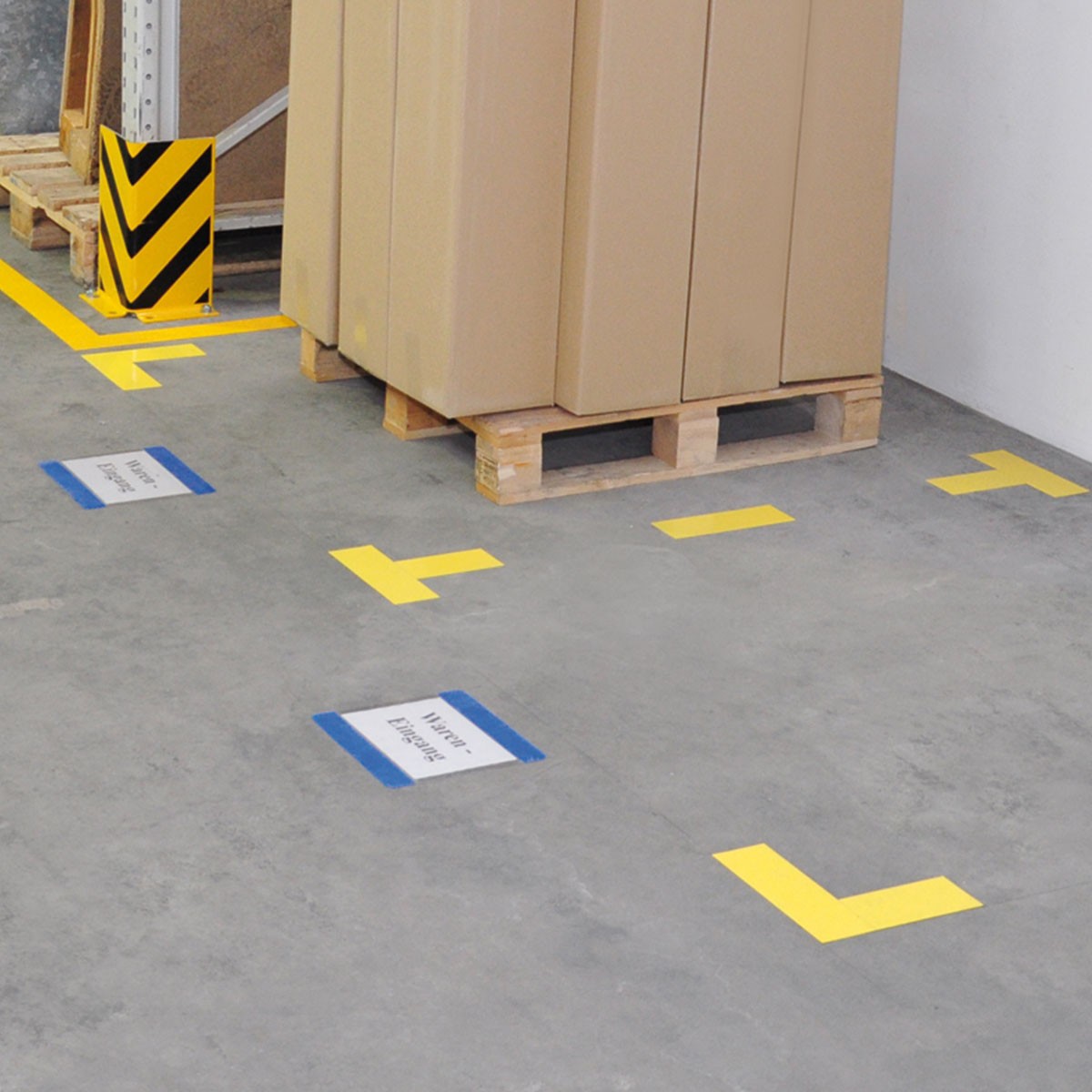
Choosing the right marking system
| Requirement | Suitable solution | Check beforehand |
|---|---|---|
| Frequently changing parking spaces | Self-adhesive, removable floor marking tape | Residues and floor compatibility |
| Permanent lines, heavy forklift traffic | Heavy-duty tape with proven suitability, segmented markings, aluminium or steel markings or 2K coating | Actual load from turning, pushing, cleaning machines |
| Rough or textured floors | Conformable tapes or liquid marking | Contact area and surface preparation |
| Outdoor areas | Weather- and UV-resistant marking | Moisture, temperature, frost |
| Freezer, cleanroom or ESD areas | Product proven for the application | Product-specific approval |
Turning forklift wheels, pushed pallets and cleaning machines stress markings very differently. "Forklift-proof" alone is not enough for selection – describe the actual load.
Distinguishing colours and safety marking
For operational organisation areas (parking spaces, storage zones, Lean/5S) define your own clear colour scheme, supplement colours with text or symbols and apply it consistently across the site.
Safety-relevant markings are subject to separate requirements. Always follow the national rules for your site. For traffic route boundaries in Germany, for example, the workplace rule ASR A1.3 (section 5.3) describes highly visible, high-contrast stripes at least 5 cm wide, preferably white or yellow. Obstacles and danger points are marked with yellow-black or red-white safety markings. A 5S colour scheme does not replace these requirements.
Installing floor marking tape – step by step
- Plan the layout: define lines, parking spaces and transitions; secure the work area.
- Check the substrate: assess cracks, holes, loose coating and moisture. No marking lasts on damaged areas.
- Remove old residues: remove adhesive residues and flaking paint completely – with adhesive remover or mechanically if necessary.
- Clean and dry: use a suitable cleaner without chlorine or citrus oils, rinse off degreaser residues and let the floor dry completely.
- Check conditions: observe application temperature and waiting times per datasheet; use primer only if intended for the system and floor.
- Apply the tape: peel off a few centimetres of liner, press down the start, then roll out the tape without stretching while gradually removing the liner. For long lines use an applicator.
- Press and finish: cut the line end with a knife and press the tape evenly and firmly with a suitable pressure roller.
- Release for use: observe the product-specific time until full load and check the edges.
Care and inspection in operation
- Inspect markings regularly – e.g. during the 5S round – for wear, lifting and damage.
- Repair or replace damaged sections promptly to avoid unclear lines or trip edges.
- Clean with mild detergent and a soft brush; avoid abrasive agents and hard scrapers on edges.
- Avoid forklift turns directly on markings; adjust the layout if necessary.
- Train employees on the meaning of the colours.
Removing or renewing markings
Test removal and adhesive remover on an inconspicuous area first – the floor coating may be more sensitive than the marking. Residues or colour differences are possible. When processes change, adapt markings and signage together.
Matching products
Floor Marking SystemsSafety signageVisual Management (Lean/5S)Cleaners & Degreasers
Frequently asked questions
More guides
Request floor marking
Tell us floor type, area, load, colours and approximate quantities – photos help. Samples on request.
This information is a general overview and does not replace applicable regulations, manufacturer instructions and your risk assessment.

Stock & Custom Solutions
Standard range from stock plus made-to-order solutions to your specifications.
Personal Expert Consultation
Direct contact with our experts – we find the technical solution for your problem.
Brand Quality
Products from renowned manufacturers – certificates and declarations of conformity per product on request.
Delivery DE & Nordics
Reliable delivery to Germany, Denmark, Norway, Sweden and Finland – Austria and Switzerland on request.