
Workplace mats
Choosing the right workplace and rubber mats
Guides
Choosing the right workplace and rubber mats
A workplace mat must suit the floor, the task and the substances at the workstation. This guide helps you collect the requirements and compare anti-fatigue mats, rubber mats and special mats in a targeted way.
Request advice on workplace mats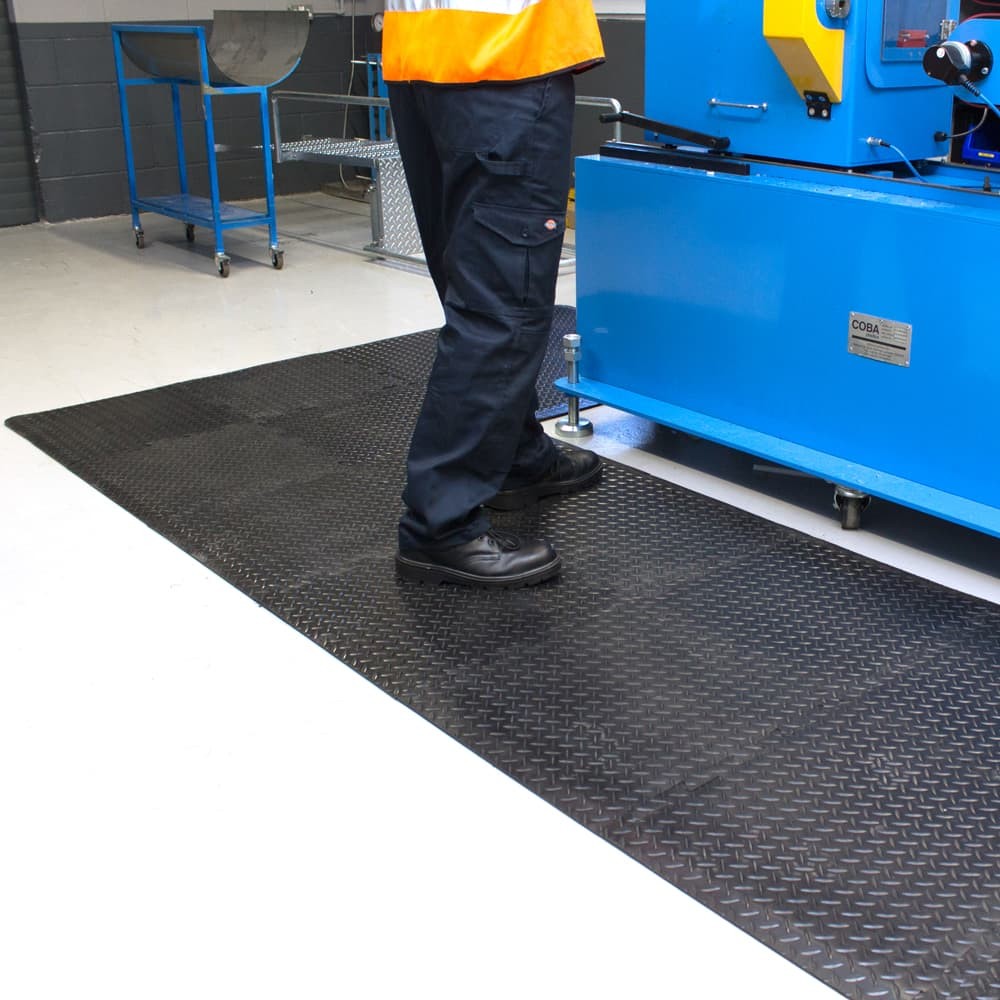
Find the right mat in a few steps
| Working environment | Pay attention to |
|---|---|
| Dry standing workstation | Cushioning, freedom of movement, safe edge and secure fit |
| Wet areas or liquids | Drainage (perforated mat), slip resistance, cleanability |
| Oils, greases, chemicals | Resistance to the specific substance (e.g. nitrile) |
| Trolleys or pallet trucks | Approval for wheel and point loads |
| ESD area | Proven ESD properties within your ESD concept – mat, earthing, floor and footwear as one system |
| Welding, heat, hygiene | Product-specific approval for the special load |
Standing comfort and safety together
Anti-fatigue mats support comfort at standing workstations. Equally important are clearly visible bevelled edges, a secure fit on the floor and sufficient movement space. A mat that is too soft or badly placed can hinder movement and wheeled traffic.
German employers' liability insurers recommend considering location, slip resistance, cleanability, weight and load when selecting mats.
Material names alone are not enough
Polyurethane, natural rubber, nitrile, EPDM and PVC come in different formulations. The material name alone proves neither chemical resistance nor temperature limits, wheel-load capacity or ESD properties.
State the actual exposure – e.g. coolant with product name, concentration, contact time and temperature – and have suitability confirmed using the datasheet.
Plan size, surface and edges
- Record the movement area including turning and reaching.
- Consider doors, wheeled routes and adjacent workstations.
- Choose single mat, roll goods or modular interlocking system to match the geometry.
- Provide bevelled edges on walkable sides.
- For drainage mats, plan fluid run-off and cleaning under the mat.
- Agree custom cuts and cut-outs in advance.
Test before a larger order
Compare samples at the actual workstation with the usual footwear. Record standing comfort, mobility, slipping and edge behaviour, and check cleaning and trolleys at the same time.
Cleaning according to manufacturer instructions
Cleaning agent, concentration, temperature and method must be approved for the specific mat. High-pressure cleaning, machine washing or autoclaving are not suitable for all rubber mats. Also clean the floor under the mat and check edges, cracks and connectors.
Matching products
Anti-fatigue matsESD Protection SystemsSlip Resistance & Safety TreadsAnti-vibration Systems
Frequently asked questions
More guides
Request advice on workplace mats
Send dimensions, floor, task, liquids or chemicals, temperature, cleaning and possible wheel loads – photos welcome.
This information is a general overview and does not replace applicable regulations, manufacturer instructions and your risk assessment.

Stock & Custom Solutions
Standard range from stock plus made-to-order solutions to your specifications.
Personal Expert Consultation
Direct contact with our experts – we find the technical solution for your problem.
Brand Quality
Products from renowned manufacturers – certificates and declarations of conformity per product on request.
Delivery DE & Nordics
Reliable delivery to Germany, Denmark, Norway, Sweden and Finland – Austria and Switzerland on request.